
Why you lose deals between calls (and how to fix it)
Most deals don't die on the call. They die in the silence after. Here's why — and how to make sure it never happens again.
The real problem isn't your pitch
You have a great call. The prospect is interested, asking questions, you feel the deal moving forward. You hang up, tell yourself "I'll follow up in two days"… and then your week happens. By the time you think about that lead again, a week has passed. They've gone cold or signed with someone else.
This isn't a closing problem. This isn't a script problem. It's a system problem. You simply don't have a reliable way to know who to follow up with, when, and why.
What the research actually says
A study published in the Harvard Business Review analyzed 1.25 million leads received by 42 companies. The finding: salespeople who contact a lead within an hour are nearly 7 times more likely to qualify it than those who wait even one hour more — and 60 times more likely than those who wait 24 hours. Follow-up speed isn't a detail. It's the deciding factor.
As for how many follow-ups it takes: Mark Roberge, HubSpot's former sales chief, published his internal data in The Sales Acceleration Formula — it took an average of 5 contact attempts to reach a small business, and up to 12 for an enterprise account. Most salespeople give up long before that. Deals don't die because someone said no. They die because you stopped following up.
The worst part? It's not the cold leads you're losing. It's the hot ones — the prospects who were ready to buy but didn't hear from you at the right time.
The fix: a next action date for every lead
The principle is simple: every lead in your pipeline should always have a planned next action with a specific date. Not "next week." Not "soon." An actual date.
After every interaction — call, email, DM — you ask yourself one question: "When should I follow up?" You note the date, and move on. The next morning, you open your list and see exactly who to contact.
Stop using your brain as a CRM
Your brain isn't built to track 30 leads with their contexts, objections, and follow-up dates. That's why the best closers use a system.
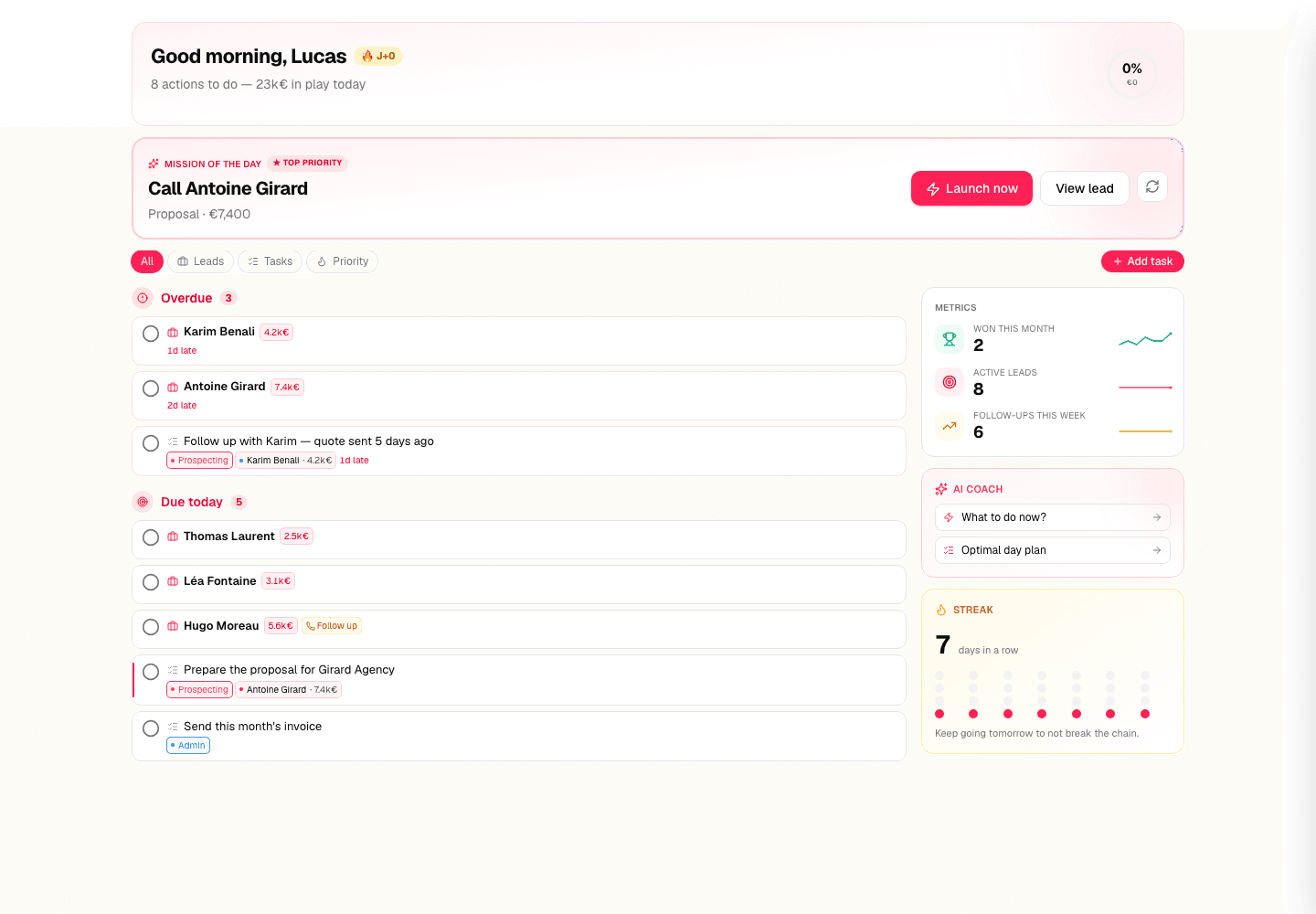
Not a bloated CRM. Just a simple tool that tells you every morning: "Here are the 5 people you need to follow up with today." You work the list, check them off, reschedule. In 10 minutes, your follow-up day is handled.
The invisible cost (and why you underestimate it)
Deals lost to forgetfulness have a vicious particularity: they leave no trace. Nobody emails you "you forgot to follow up, I'm signing elsewhere". The prospect just disappears. No refusal, no feedback, no sharp pain — just a silence that looks like every other silence.
As a result, you see very clearly the deals lost on price or to a competitor (they hurt), but you never see the ones lost to forgetfulness. So you structurally underestimate your first source of untapped revenue: the warm leads that were just waiting for a follow-up at the right time. That's exactly why most independents think they have a closing problem when they have a follow-up problem.
Set up the system in 15 minutes
No transformation project needed. Tonight:
- List your active leads — every place they're sleeping: DMs, emails, notes (the inventory method is here).
- Give each one a next action date. Even approximate: tomorrow, in 3 days, in a week.
- Tomorrow morning, open your list and follow up with whatever is due — that's the 5-minute routine.
- Repeat. The system does the rest.
You can set all of this up on Axoloti for free (up to 10 leads, no credit card) — and from there, no deal will ever die in silence again.
Ready to stop losing deals to forgetfulness?
Get started free — up to 10 leads, no credit card.
Start for free