
The complete guide to lead tracking in 2026: from prospecting to closing
Everything you need to know to organize, follow up and convert your prospects. The reference guide for freelancers and small teams.
Introduction: why lead tracking is the #1 sales skill
You can have the best product, the best pitch, the best price — if you don't follow up with leads at the right time, you lose sales. It's that simple.
Two verifiable data points to frame the topic. First, the study "The Short Life of Online Sales Leads" (Harvard Business Review, 1.25 million leads analyzed): contacting a lead within the hour makes you 7 times more likely to qualify it than waiting one hour more. Second, HubSpot's internal data published by Mark Roberge in The Sales Acceleration Formula: it takes an average of 5 to 12 contact attempts depending on the size of the client. Speed and persistence — exactly what a tracking system gives you.
This guide covers everything you need to set up an effective lead tracking system in 2026.
Chapter 1: Centralize your leads
Step one: have a single place for all your prospects. Not an Excel file plus a notebook plus unread DMs.
Pick a tool (Kanban pipeline, simple CRM, or a well-structured spreadsheet) and make it your single source of truth. Every lead, regardless of source, goes in it.
Minimum info per lead:
- Name and company
- Contact channel (DM, email, call, form)
- Potential deal amount
- Current stage (new, contacted, discussing, proposal sent)
- Next action date
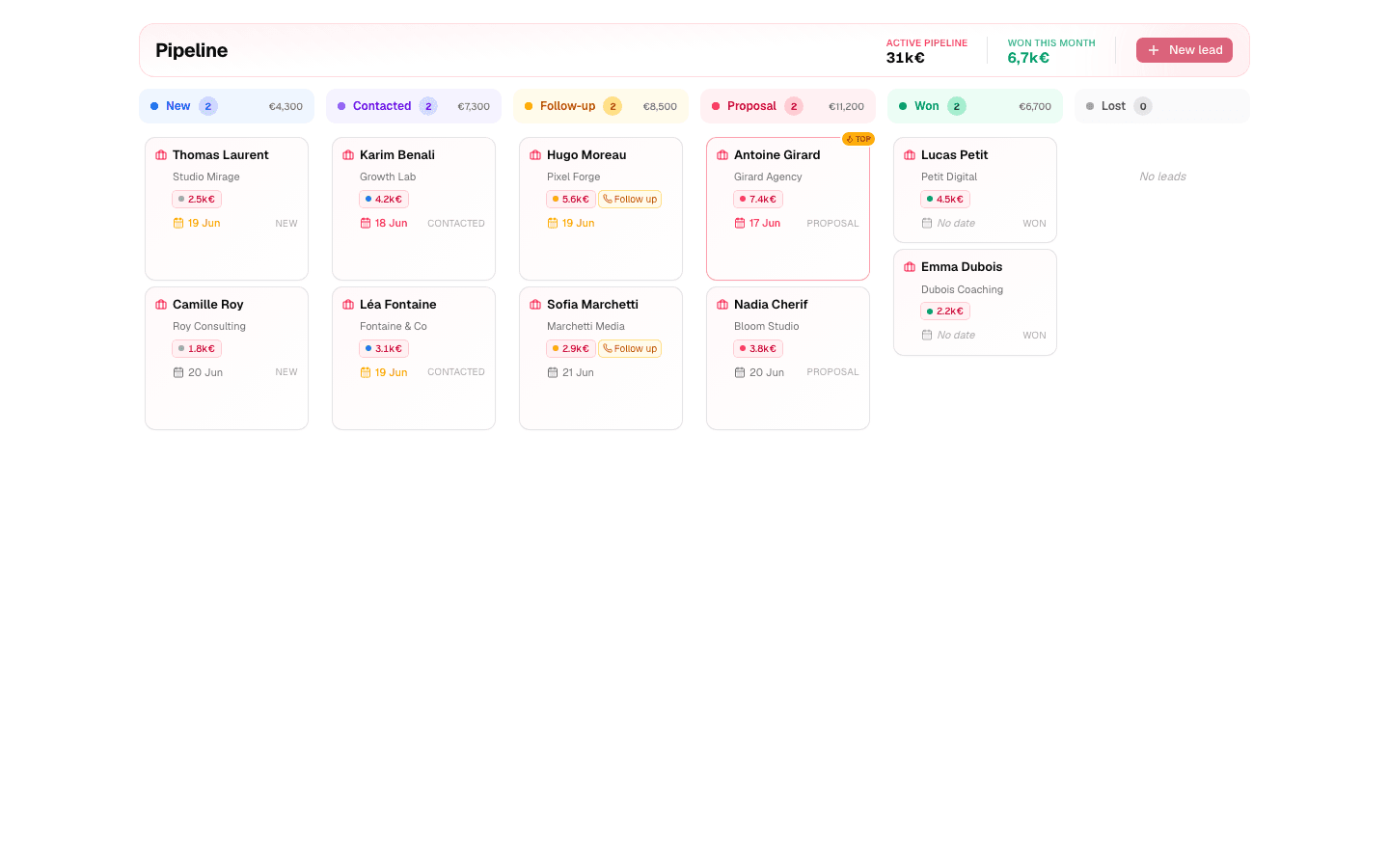
Chapter 2: The 6 stages of a sales pipeline
New — Lead just came in. Not contacted yet. Goal: make first contact within 24h.
Contacted — First contact made (email, call, DM). They know you exist. Goal: qualify the need and schedule a call.
Follow-up — In discussion. Lead showed interest but hasn't received a proposal. Goal: understand needs and prepare an offer.
Proposal — Quote or proposal sent. Lead is thinking. Goal: follow up to address objections and close.
Won — Deal signed. Note the amount, date, and analyze what worked.
Lost — Deal didn't happen. Note the reason (price, timing, competitor, no response). Every loss is a lesson.
Chapter 3: The golden rule — every lead has a next action date
This is THE rule that changes everything. Every lead in your pipeline must have a next action date. Not "soon." Not "next week." A specific date: 2026-04-15.
Why it works:
- You always know what to do when you open your tool in the morning.
- No lead falls through the cracks.
- You naturally prioritize (past dates = urgencies).
A lead without a next action date is a forgotten lead. Period.
Concrete example: Friday call with Sarah, interested but "I need to talk to my partner." Instead of a vague "I'll check next week," you note: next action Tuesday — "follow up with Sarah, partner decision." Tuesday morning she shows up in your list, and you follow up at the exact moment she was expecting to hear from you.
Chapter 4: The 5-minute daily routine
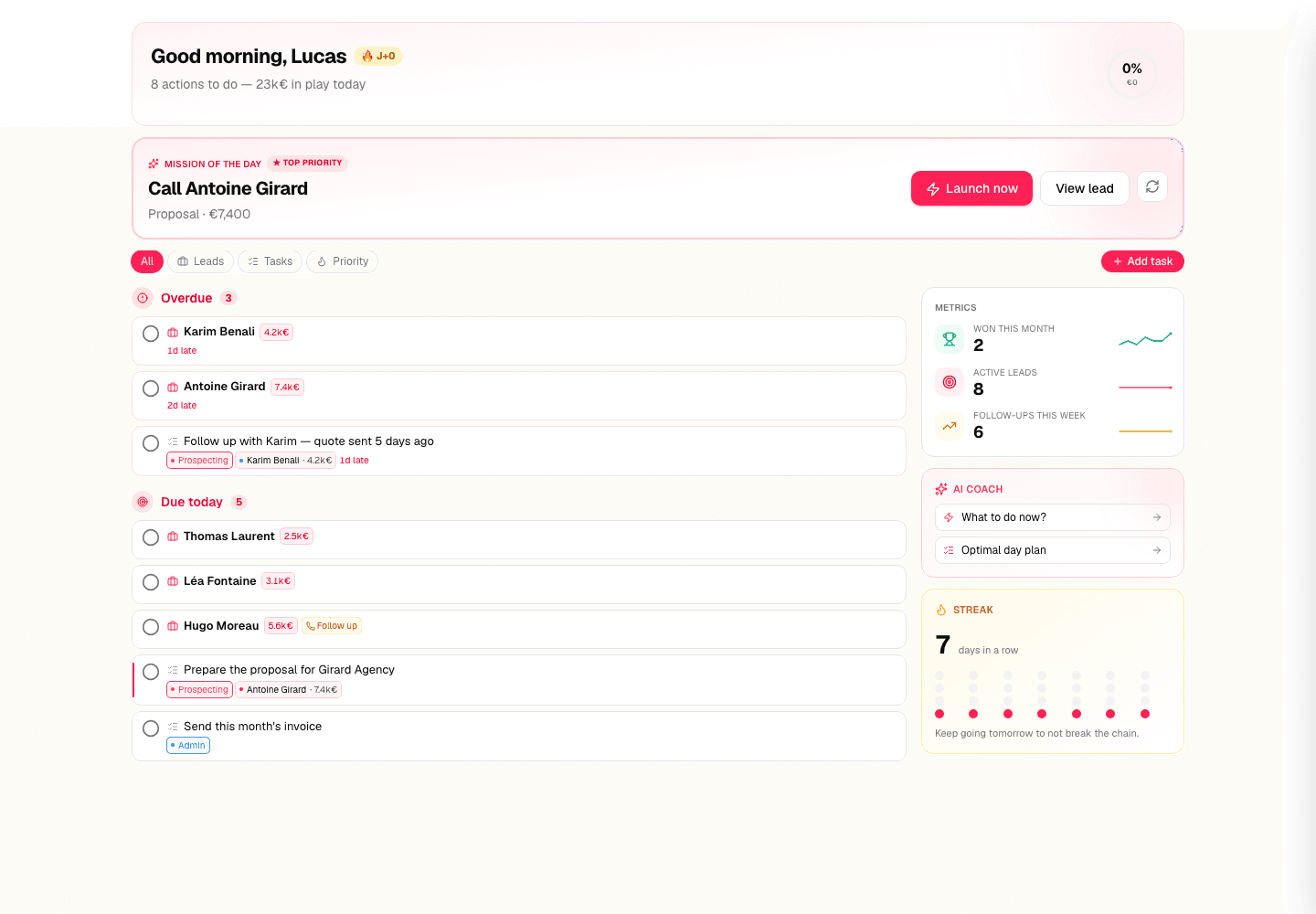
Every morning, before anything else:
- Open your Today view — the list of leads to follow up with today or overdue.
- Follow up in order — start with overdue (urgencies), then today.
- Mark as done — after each action, check off and set the next date.
- Add new leads — if you got prospects last night, add them.
5 minutes. Every day. No exceptions. Over a quarter, it's not motivation that makes the difference — it's this consistency.
Chapter 5: How to follow up well (without being annoying)
5 rules for good follow-ups:
1. Add value. Don't say "just checking in." Bring info, a concrete case, an answer to an objection.
2. Keep it short. 2-3 lines max. The prospect is busy.
3. Personalize. Mention a detail from your conversation. Show you listened.
4. Vary channels. Email, LinkedIn, phone, text. Don't stick to one channel.
5. Know when to stop. After 5-6 follow-ups with no response, send a breakup message. Professional and respectful.
For concrete, ready-to-adapt examples (subject lines included), see our 7 follow-up email templates.
Chapter 6: Metrics to track
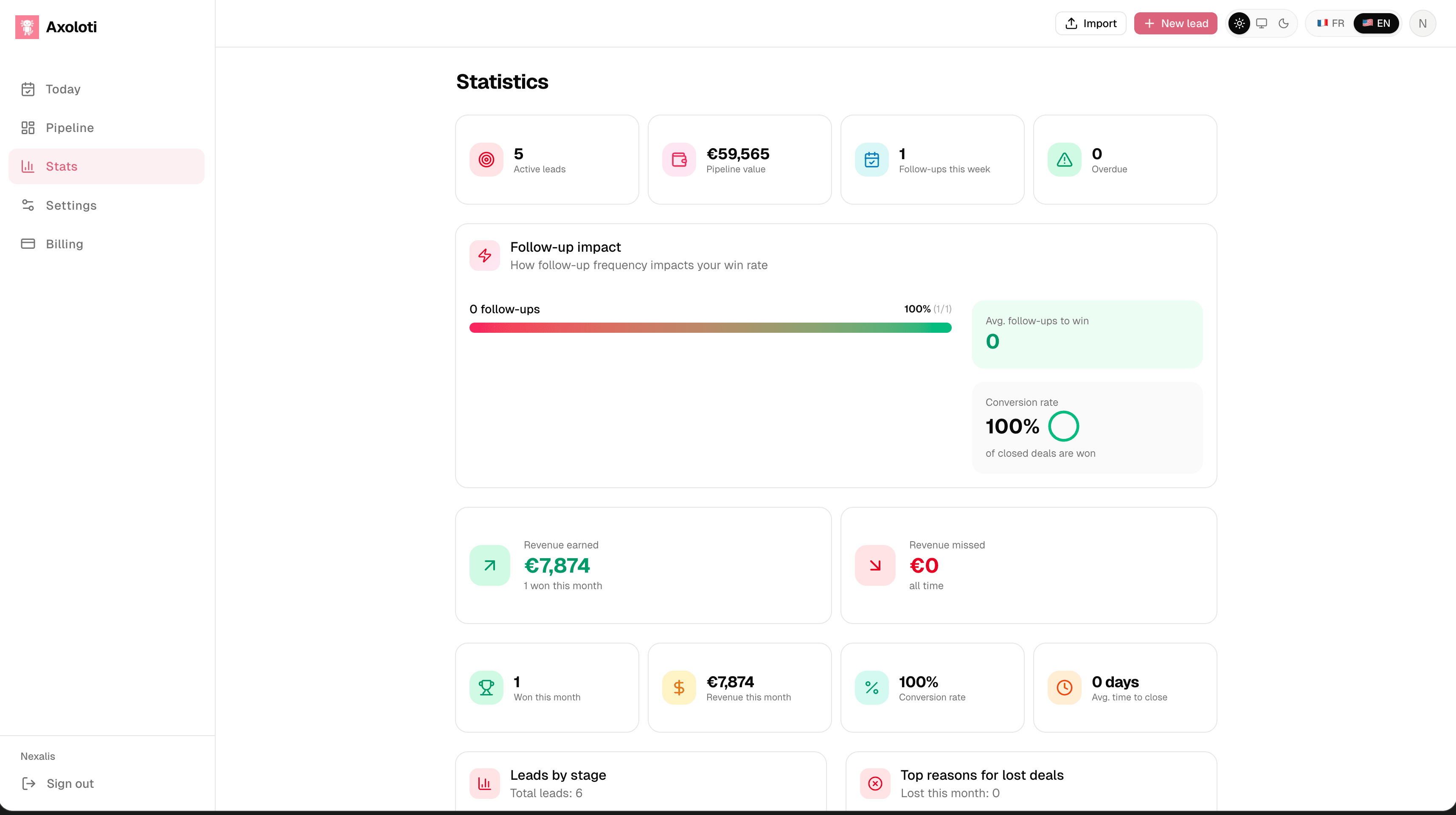
To improve your sales process, measure these:
- Active lead count — how many prospects you're managing right now.
- Conversion rate — won / (won + lost). The "right" value depends too much on your industry for a universal target: track your trend month over month.
- Average time to close — from first contact to signed deal.
- Average follow-ups — how many before closing. If you're at 1-2, you're not doing enough.
- Loss reasons — why you lose deals. If "no response" dominates, your follow-up is insufficient. If "price" dominates, revisit positioning.
- Monthly revenue won — the ultimate KPI. Is your tracking system earning you more?
Chapter 7: Choosing the right tool
You don't need an expensive or complex tool. You need one you'll use every day.
Selection criteria:
- Daily view: does it show me who to follow up with today?
- Visual pipeline: can I see leads by stage at a glance?
- Reminders: does it remind me of forgotten follow-ups?
- Simplicity: can I start in 5 minutes?
If you want absolute simplicity, try Axoloti — it's exactly what it was built for. And for a detailed comparison of the options (HubSpot, Pipedrive, noCRM, Notion, Excel), read our freelance CRM comparison 2026.
Chapter 8: The 5 mistakes that sink a tracking system
1. Keeping it in your head. If your system depends on your memory, it's not a system.
2. Multiplying stages. 12 columns in your pipeline = you'll never know where to file a lead. 6 stages are enough.
3. Leaving leads without a date. A lead without a next action is invisible to your daily routine. That's exactly how things get forgotten.
4. Writing everything down except what matters. Your notes should answer one question: "what do I say in my next follow-up?". They're not a diary.
5. Quitting at the first gap. You will miss days, that's certain. What matters isn't perfection: it's opening your list again the next morning. A system is judged over a month, not a day.
Conclusion: tracking is a competitive advantage
Most of your competitors don't follow up. Or they follow up once and quit. By setting up a structured tracking system, you gain a massive advantage.
Remember:
- Every lead has a next action date.
- You open your list every morning.
- You follow up, reschedule, close.
Simple. Devastatingly effective. And it's what separates freelancers who survive from those who thrive.
To go further: how many times to follow up, what to write in your follow-ups, and which tool to choose.
Ready to stop losing deals to forgetfulness?
Get started free — up to 10 leads, no credit card.
Start for free