
Quote sent, no reply: when and how to follow up (5 ready-to-send messages)
You sent the quote and got radio silence? The right timing to follow up, 5 messages ready to adapt, and the system that keeps a proposal from dying quietly.
Silence after a quote is not a no
You spent two hours on that quote. You sent it on Tuesday with a friendly note. Since then: nothing. No refusal, no question, no acknowledgement. Just silence.
First thing to understand: a quote with no reply is almost never a "no." In the vast majority of cases, the prospect simply moved on to something else. A meeting ran long, a partner needs consulting, two other quotes need comparing, or it just feels like "this can wait until next week." On their side, your quote is one line in an inbox. On yours, it's the deal of the month.
That attention gap is the key to everything that follows: you think about this quote every day; they thought about it for thirty seconds the day it arrived. Following up isn't pushing — it's putting your quote back in front of them at the moment they can finally deal with it. We break down the mechanism in how to follow up without being annoying.
The right timing: day 2, day 7, day 14, then close
A quote's worst enemy is time passing without a word from you. The longer you wait, the colder the prospect gets — and the more your follow-up feels like an awkward reappearance.
The rhythm that works for a commercial proposal:
- Day 2: an acknowledgement disguised as a question. You check the quote arrived and is readable, and you open the door to questions.
- Day 7: a value-add follow-up. A similar client case, a clarification on one line of the quote, an option you hadn't mentioned.
- Day 14: the decision follow-up. You ask straight out what's blocking — budget, scope, timing — and offer to adjust.
- Day 21 to 30: the breakup message. You close the file cleanly and leave the door open.
Four to five touches over a month: that's the tempo of an organized professional, not a desperate seller. The data Mark Roberge (HubSpot's former sales chief) published in The Sales Acceleration Formula points the same way: it took an average of 5 attempts to reach a small business, and up to 12 for an enterprise account. One follow-up after a quote means stopping right when it starts to pay off. To adapt this rhythm to how warm the lead is, see how many times to follow up.
Before you follow up: three checks that change everything
Before sending any follow-up, take two minutes to check three things — they prevent most of the follow-ups that fall flat.
- Does your quote end with a question? A quote that ends with "feel free to get back to me" invites no reply. A quote that ends with "shall we book 20 minutes on Thursday to walk through it?" does. If your proposal has no explicit next step, your first follow-up's job is to set one.
- Does your quote have an expiry date? A real validity date (price locked until the 30th, start slot held until the 15th) gives you a legitimate reason to follow up on day 14 — without inventing fake urgency.
- Did you write down the date of your next follow-up? This is the check almost nobody does — and the one that matters most. A quote sent without a scheduled follow-up date is a quote you'll follow up on "when you think of it." Which means never, or too late.
5 quote follow-up messages ready to adapt
The five messages below follow the rhythm from the previous section. Adjust the tone to your relationship with the prospect.
1. Day 2 — check and open the door
Subject: Quote for [project] — all clear?
"Hi [first name], I wanted to make sure the quote I sent on Tuesday reached you and that everything is readable. If anything needs clarifying — the scope, the timeline, an option — let me know and I'll get back to you today."
Why it works: zero pressure, a concrete reason to write, and an invitation to ask the question that may already be blocking.
2. Day 7 — bring something
Subject: A case close to [their project]
"[First name], thinking back on your project, a case came to mind: [type of client], same problem, [result in one sentence]. Happy to walk you through how we did it if it helps you picture things. And on the quote — where are you in your thinking?"
Why it works: you give before you ask. The prospect gains a decision input, not a reminder of a debt.
3. Day 14 — lift the blocker
Subject: Anything to adjust in the quote?
"[First name], I'd rather ask straight out: is something in the proposal getting in the way — budget, scope, timing? If so, I'd rather adjust than guess. And if the project is simply pushed back, tell me and I'll follow up at the right time."
Why it works: you name the three classic objections and offer an honest way out. Many prospects reply here, sometimes to say "not now" — which is gold for your planning.
4. Day 14 (alternative) — the expiry date, if you have one
Subject: Quote valid until [date]
"[First name], quick reminder: the price in the quote is locked until [date] — after that I won't be able to hold [the start slot / the terms]. Want to talk it through before then?"
Why it works: a real deadline helps people decide. Careful: if it's fake, you lose your credibility for good.
5. Day 30 — close cleanly
Subject: Shall I close the file?
"[First name], I understand the timing isn't ideal. I'll file the quote so I don't clutter your inbox — if the project comes back on the table, just say so and we'll pick up where we left off. All the best."
Why it works: paradoxically, this is often the message that gets the most replies. It lifts the pressure and forces a decision.
For other situations (after a call, after an event, after a long silence), pick from our 7 follow-up email templates.
What not to do
- Following up with nothing new. "Did you have time to look at my quote?" three times in a row is three chances to be ignored. Every follow-up must add an element: a clarification, a case, a new question.
- Cutting the price unprompted. An unrequested discount after a silence sends a terrible message: "my price wasn't serious." If budget is the blocker, it's the prospect's job to say so — and you adjust scope before price.
- Blaming the silence. "Having had no reply from you...", "I notice that...": guilt-tripping a prospect has never made them sign.
- Hitting every channel the same day. Email in the morning, LinkedIn at noon, a call in the afternoon: that's not following up, that's surrounding. Switch channels after two unanswered attempts, not before — and if you move to LinkedIn, here are the messages that work.
- Giving up after one follow-up. The most common mistake, and the most expensive. The prospect didn't say no: you just stopped asking.
The system that makes following up automatic
Everything above fits in one sentence: a quote you've sent must always have a next follow-up date. The problem is that your memory is a terrible tool for that — especially with six quotes in flight, three calls a day and an overflowing inbox.
The method that holds up over time:
- The moment you send the quote, move the lead to "Proposal" in your pipeline and set its next action: day 2.
- Every morning, your daily list shows the quotes to follow up on — overdue first. You send the message that fits the moment (day 2, day 7, day 14...), log it, and schedule the next one. Five minutes — that's the routine.
- At the end of the cycle, you close: won, or lost with a reason — plus a reactivation date 3 to 6 months out if the "no" sounded like "not now."
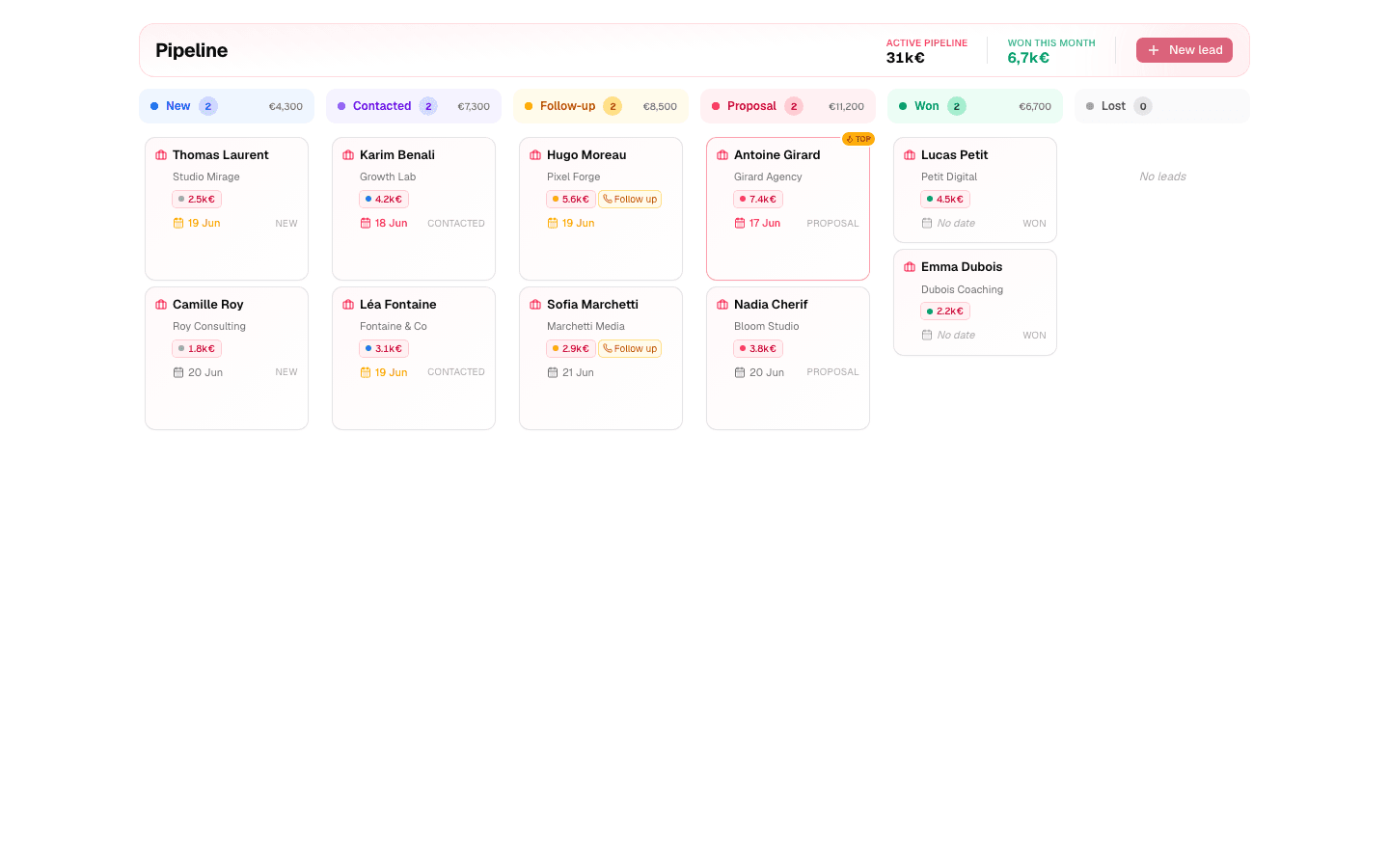
That's exactly what Axoloti does: every quote has its date, every morning you see which ones to follow up on, and no proposal dies in silence anymore. Free up to 10 leads, no credit card.
Ready to stop losing deals to forgetfulness?
Get started free — up to 10 leads, no credit card.
Start for free