
Reactivating a cold lead: follow up with an old prospect without being awkward
A prospect who went quiet isn't necessarily lost. Here's how to re-engage an old lead, with the right messages, without looking desperate.
A quiet lead isn't a dead lead
You almost certainly have a folder full of prospects who never replied, or who said "not now." Most freelancers write them off and forget them. That's a mistake.
In sales, a "no" often means "not now." The budget wasn't there, the timing was off, the priority was elsewhere. Three months later, all of that may have changed — but if you don't follow up, you'll never know. The lead didn't disappear: they just stopped thinking about you.
Why it beats chasing a new lead
Re-engaging an old prospect takes far less energy than finding a new one: you already have the contact, the context, and a past conversation to build on.
And persistence pays. In The Sales Acceleration Formula, Mark Roberge (HubSpot's former sales chief) reports it takes an average of 5 contact attempts to reach a small business — up to 12 for an enterprise account. Most salespeople stop at the second. The ones who follow up with old leads recover deals their competitors abandoned.
The rule: never delete a prospect. Mark them lost with a reason, and keep a reactivation date.
The right moment, the right reason
Following up "just to check in" isn't enough — it reeks of a desperation nudge. You need a legitimate reason to reappear:
- A trigger on their side: they raise funding, hire, launch a product. Congratulate, then tie it back to your offer.
- Something new on your side: a new service, a recent client result, a plan that fits them better.
- Useful content: an article, a concrete case, a resource that answers their problem.
The right moment is when you can bring something — not when you need to sell.
3 reactivation messages that get a reply
1. The value reminder. "Hi Marc, I was thinking back to our chat about [problem]. We just helped [similar profile] achieve [concrete result]. Still relevant on your end?"
2. The light check-in. "Hi Julie, it's been a while! Where are you on [project]? If it's back on the table, I'm here."
3. The breakup that reopens. "I'm closing your file so I don't clutter your inbox — just tell me if I should reopen it later, or if the need is gone." Paradoxically, this is often the message that gets a reply.
In all three: short, no pressure, one question. For more ready-to-adapt examples, see our 7 follow-up email templates.
Never forget them again: schedule the reactivation
The difference between a reactivated prospect and a forgotten one comes down to one thing: did you note when to follow up?
When a deal doesn't happen, don't delete it. Move it to "Lost" with the reason (price, timing, competitor), then set a reactivation date 3 to 6 months out. When that day comes, it reappears in your list, and you follow up at the right time — without having to think about it in between.
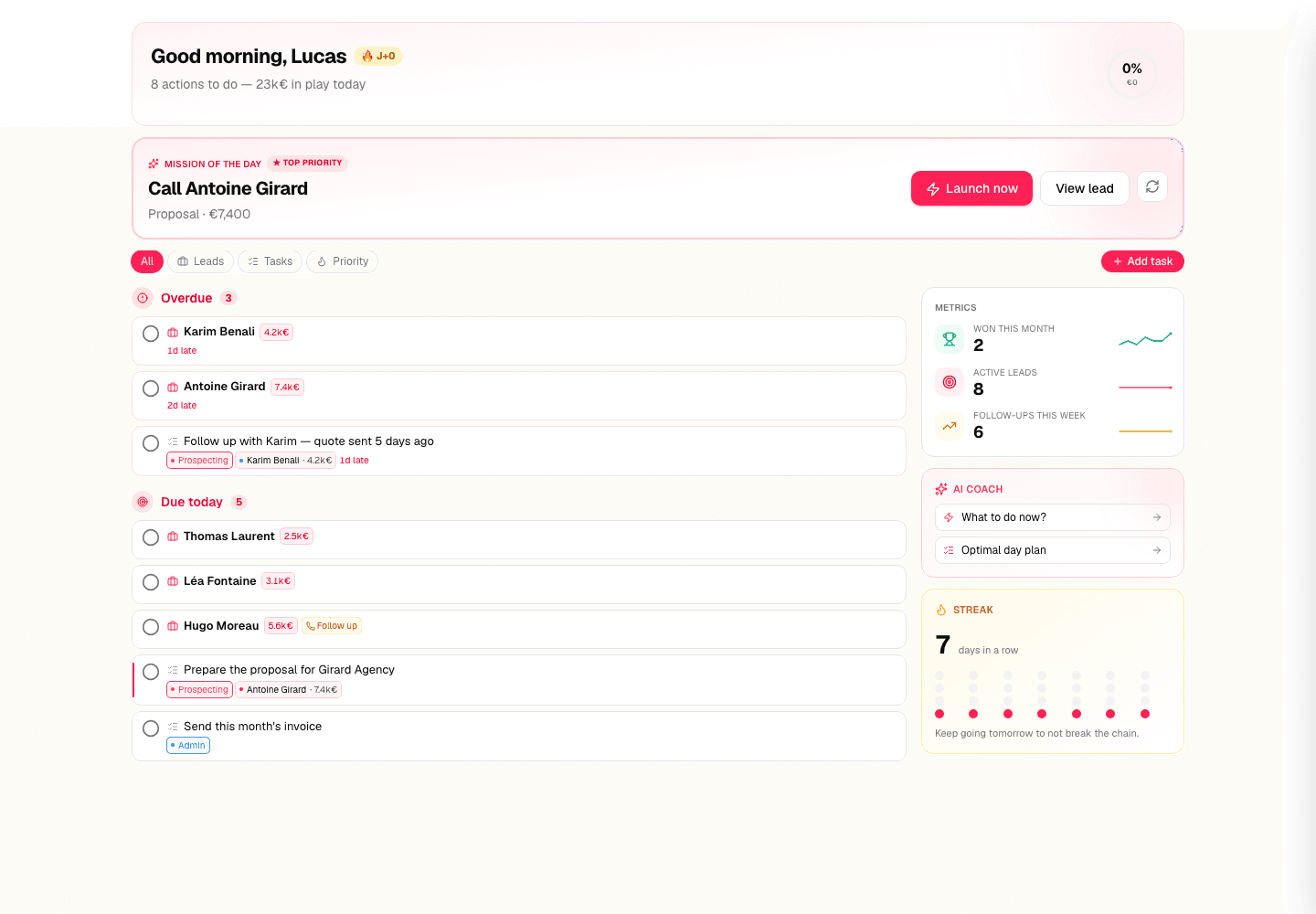
That's exactly what a next action date does: it turns "I should have followed up" into "they're in my list today."
To go further: how many times to follow up.
Ready to stop losing deals to forgetfulness?
Get started free — up to 10 leads, no credit card.
Start for free